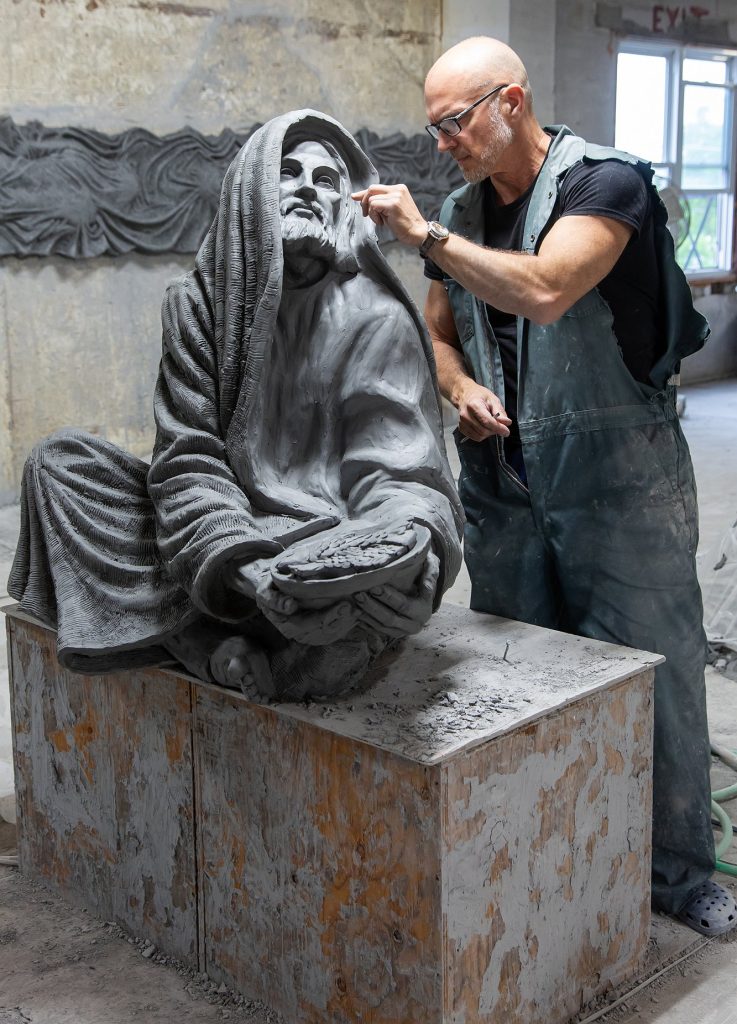
The piece is a direct translation of Matthew 25:35 — “I was hungry and you gave me something to eat, I was thirsty and you gave me something to drink.” Schmalz has described the sculpture coming together fast: he prepared a large amount of clay on Good Friday and began sculpting straight onto his studio floor, with the figure fully formed by Easter Monday just a few days later.
Installed in 2006, it was the first sculpture Schmalz ever placed in Rome — and, by his own account, one that meant a great deal to him. He’s told the story of meeting with the hospital about the installation without a shared language between them: no Italian on his side, no English on theirs. He showed them a photo of the clay model, and that was enough — they understood immediately, and asked to install it right beside the hospital’s own sign.
Where it was installed matters as much as the sculpture itself. Santo Spirito is considered the oldest hospital in the world, founded on the belief — radical for its time — that caring for the sick and poor was a sacred duty, not simply misfortune to be ignored. Schmalz has also pointed out a detail from his own research into the hospital’s history: when Martin Luther visited Rome and was famously scathing about the city, Santo Spirito was one of the only things he had good things to say about — a detail independently backed up by historical accounts of Luther’s trip.
Schmalz has spoken about wanting the piece to work as a kind of visual medicine: something that interrupts the normal instinct to walk past a person on a corner without seeing them.